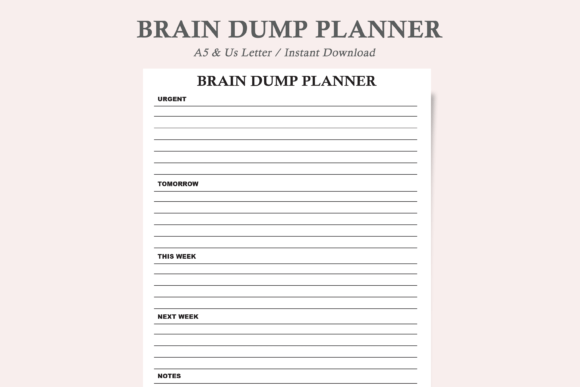
The Brain Dump Planner as a Modern Thought Organizer
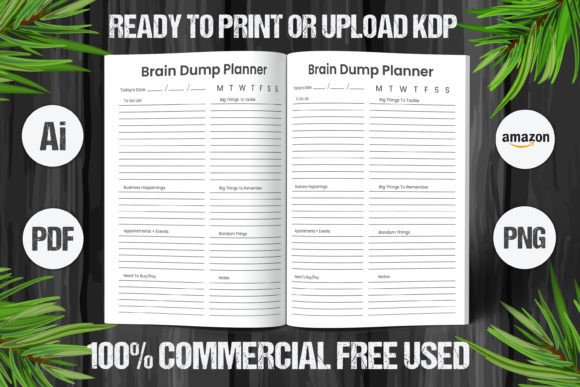
Most people carry an invisible weight throughout the day. It is not physical, but it slows decision-making, fragments attention, and quietly drains productive energy. The weight comes from unprocessed ideas, half-formed tasks, and mental notes that never found a home. A Brain Dump Planner addresses this directly. It functions as a structured Thought Organizer, giving shape to the swirling mental chatter that accumulates between morning meetings, creative projects, and everyday responsibilities. The concept is simple but increasingly relevant in a world where cognitive demands consistently outpace the default systems we use to manage them.
What distinguishes purposeful mental offloading from scribbling on sticky notes is intention. When someone sits down with a page designed specifically for capturing unfiltered thoughts, the brain shifts modes. Instead of juggling, it begins sorting. The planner becomes a temporary external drive, holding everything until the mind is clear enough to evaluate what actually deserves attention. This practice has moved beyond bullet journal enthusiasts and into broader professional and creative circles precisely because it bridges a gap that digital tools have struggled to close fully.
Why Structured Brain Dumps Matter More Now
Notification fatigue has reshaped the way people relate to their own thoughts. Pings, badges, and infinite scroll designed to retain attention also fragment it. Reclaiming mental space is not just a wellness trend; it has become a practical necessity for knowledge workers, entrepreneurs, students, and anyone balancing multiple roles. The Thought Organizer aspect of a brain dump planner offers a deliberate pause, a physical or printable space where the digital noise temporarily stops. This manual slowing-down counteracts the reactive thinking patterns that screens encourage.
Parallel to this is the growing openness around neurodivergence, particularly adult ADHD. Many individuals have discovered that standard planning methods fail not because of laziness but because they presuppose a linear thought process that does not match lived experience. An ADHD brain dump page acknowledges that thoughts can arrive out of order, with varying intensity, and at inconvenient times. By removing the pressure to prioritize before capturing, the planner becomes a low-friction entry point. Users can empty everything—worries, creative sparks, grocery reminders, long-term ambitions—onto the same page without self-editing. Organization happens later, when the mental bandwidth for it has been restored.
The Link Between Mental Clutter and Analysis Paralysis
Analysis paralysis often disguises itself as thoroughness. In reality, it frequently stems from having too many unprocessed inputs competing for the same cognitive resources. When every option feels equally urgent because none have been evaluated, forward motion stops. An Analysis Paralysis Planner section within a brain dump framework breaks this cycle by creating spatial separation between capturing and deciding. The act of writing things down externalizes them, turning an overwhelming internal monologue into a visual inventory that can be grouped, crossed out, or deferred with clarity.
Consider a freelance designer juggling three client projects, personal errands, and a side business idea. Without a dedicated dump session, each context bleeds into the others. The designer stares at a blank screen, unable to start because emails, invoices, and creative concepts all feel simultaneous. A fifteen-minute brain dump onto a Thought Tracker page surfaces what was actually causing the block: a forgotten follow-up email that the brain had been unconsciously holding onto. Once written down and scheduled, the creative work became accessible again. This is not about productivity theatre; it is about understanding that working memory has tight limits and that offloading is a performance multiplier.
Thought Tracking as a Daily Feedback Loop
Repeated use of a Thought Journal turns scattered entries into recognizable patterns. Over weeks, a user might notice that certain worries resurface on Sunday evenings or that creative ideas cluster after morning exercise. These observations are valuable beyond the immediate relief of clearing the mind. They become data points for designing better routines. The Organization planner function evolves from a one-time dumping ground into a reflective tool that helps the user anticipate mental friction and plan around it proactively.
Professionals in high-ambiguity roles find particular value in this recursive quality. A marketing strategist tracking campaign ideas through daily dumps can trace how a fledgling concept matured or why a promising direction stalled. The paper trail reveals creative rhythms that might otherwise remain invisible. For educators managing lesson plans, research, and student communications, a dedicated brain dump page at the end of the workday serves as a cognitive reset, ensuring that unresolved items are captured rather than carried into personal time.
Mental Organization as the Foundation of Goal Setting
Goal setting is often celebrated as a high-level strategic exercise. You define objectives, reverse-engineer milestones, and commit to timelines. Yet many carefully crafted goals collapse because the day-to-day mental noise was never cleared to make room for sustained focus. Mental Organization is the preparatory step that many frameworks skip. Before meaningful priorities can be set, the mind needs to be emptied of its current inventory. Otherwise, new goals simply compete with old, unarticulated ones.
A brain dump planner integrates Goal Setting by first creating vacancy. After a thorough dump, the user can scan the captured items and categorize them: immediate tasks, upcoming projects, aspirational ideas, delegated items, and discardable noise. What remains is a cleaner landscape in which authentic priorities surface more naturally. This bottom-up approach feels more honest than top-down goal templates because it starts with what is actually occupying mental real estate, not what should theoretically be important.
Task Organization and the Art of Letting Go
Task Organization within this context is not about filling every hour with productivity. It is about intentional triage. Once thoughts are externalized, the user can apply gentle criteria: Does this need action this week? Is this someone else's responsibility? Is this a repeating anxiety rather than a solvable task? The minimalist design often found in printable brain dump planners supports this clarity. Without decorative overwhelm, the page itself communicates that the primary objective is clarity, not aesthetic perfection.
The ink-friendly design mentioned in connection with these planners matters more than one might assume. When a tool is visually restrained, the user is not subconsciously performing for the page. The focus stays on the content. Additionally, the practical aspect of being able to print a new page whenever needed removes the scarcity mindset that sometimes accompanies bound journals. If a particular dump session is messy or emotionally charged, that page can be destroyed, filed, or revisited without affecting the rest of the system. This flexibility lowers the psychological barrier to honest expression.
Creative Thinking and the Unfiltered First Draft
Creativity research consistently points to the value of divergent thinking before convergent thinking. Yet many creative professionals rush to refine ideas before they have fully explored them. A brain dump planner supports Creative Thinking by legitimizing the messy, incomplete, and contradictory stages of ideation. When a Productivity Tool is designed to accommodate disorder before demanding order, it aligns better with how original ideas actually develop.
A writer developing a story concept might dump character traits, plot fragments, thematic questions, and sensory details across a page without organizing them. The visual scattering often reveals unexpected connections. A software developer mapping a new feature could use the same method to capture edge cases, user concerns, and technical constraints in one unfiltered session. The common thread is that creativity benefits from temporary suspension of judgment, and a structured brain dump page provides exactly that containment.
Practical Application Across Different Contexts
Small business owners frequently wear multiple operational hats. The cognitive load of switching between marketing, fulfillment, customer service, and financial planning creates a background hum of anxiety that can dull decision-making. A weekly brain dump ritual, using a printable Thought Organizer, allows them to offload cross-context items before planning the week ahead. The key is consistency, not volume. Even ten minutes of unfiltered writing can sufficiently clear the mental workspace.
For hobbyists and makers, the benefits extend beyond task management. A woodworker experimenting with new designs might use brain dump pages to capture inspiration, material constraints, and safety considerations without prematurely committing to a plan. The flexibility of a digital download means the planner adapts to the user's rhythm rather than imposing a dated structure. When a page is filled, a fresh one is printed. When a project is completed, the related pages can be archived or discarded. This modularity respects that different seasons of life demand different levels of cognitive externalization.
Integrating the Planner into Modern Workflows
Digital calendars and task managers excel at reminders, recurring events, and collaborative visibility. Where they falter is in handling the ambiguous, the emotional, and the not-yet-actionable. A brain dump planner complements these tools by serving as the intake layer. The morning dump captures what surfaced overnight. The midday dump resets focus after a meeting-heavy block. The evening dump prepares the mind for rest by parking unresolved items safely on paper.
This hybrid approach is gaining traction among professionals who find purely digital systems either too rigid or too easy to ignore. The tactile act of writing activates different neural pathways than typing, which may partly explain why handwritten brain dumps often feel more thorough and satisfying. Users report that the physicality of the page makes commitments feel more concrete, even if those commitments are later digitized for tracking.
Common Objections and Realistic Expectations
Some individuals hesitate to adopt a brain dump practice because they worry it will become another chore. The distinction lies in framing. Unlike a gratitude journal or a structured planner with daily prompts, a brain dump page imposes no formatting requirements. The absence of mandatory fields reduces resistance. If a user has nothing to dump, the page stays blank without guilt. More often, the opposite happens: once the pen starts moving, the backlog reveals itself.
Another concern is that dumping thoughts might amplify negativity or rumination. The structure of an Analysis Paralysis Planner mitigates this by encouraging movement from capture to categorization. Thoughts are acknowledged but not dwelt upon indefinitely. The categorization step naturally separates constructive concerns from circular worries, and the act of assigning a simple status—action, defer, discard—reduces the emotional charge of many items. The planner does not promise to eliminate stress but to externalize it in a manageable format.
The Quiet Evolution of Analogue Tools
In a market saturated with productivity apps offering AI summaries and smart suggestions, the resurgence of printable planners might seem counterintuitive. Yet the appeal is precisely their lack of intelligence. Analogue tools do not predict, nudge, or monetize attention. They sit passively until engaged with deliberately. This quality aligns with a growing awareness that constant algorithmic assistance can atrophy the very cognitive muscles people seek to strengthen. A Brain Dump Planner Thought Organizer represents a conscious choice to reclaim agency over one's mental processes.
The availability in two sizes, US letter and A5, acknowledges practical user preferences. US letter suits those who want expansive space for sprawling mind maps and detailed breakdowns. A5 offers portability and discretion, fitting into bags or drawers without demanding dedicated desk space. The option to print repeatedly from a single purchase removes the friction of running out of pages or committing to a bulky bound planner that may go unused. This accessibility aligns with sustainable consumption patterns and budget-conscious habits.
Recommendations for Building a Sustainable Practice
Start with curiosity rather than obligation. Experiment with different times of day to see when mental clutter peaks. Some find mornings ideal, before digital inputs flood in. Others prefer mid-afternoon, when context-switching fatigue accumulates. The goal is not to produce elegant pages but to achieve a felt sense of cognitive release. Over time, the practice tends to refine itself. Certain categories of thought will surface repeatedly, revealing underlying priorities or unresolved tensions that merit deeper attention.
Pair the brain dump with a brief review step. Glancing back over the page after the dump and marking items with simple symbols—a circle for action, a line through for discard, an arrow for deferral—completes the cycle. Without this review, the dump remains a collection of noise rather than a launchpad for focused Goal Setting and Task Organization. Even two minutes of review transforms the experience from catharsis into a practical planning ritual.
Finally, remember that the tool serves the user, not the reverse. Some weeks may call for daily dumps. Others may need only a single weekend session. The design philosophy behind a minimalist, ink-friendly brain dump planner supports this fluctuation. There are no blank pages to shame the user and no complicated indexing systems to maintain. It is a responsive tool, ready when the mind is full and unobtrusive when it is not.