100 Mental Health Journal Prompts KDP
Mental health journaling can feel overwhelming when the first blank page stares back. That’s where a structured resource like 100 Mental Health Journal Prompts KDP changes everything. It’s not merely a list — it’s a complete, editable Canva-based template designed for creators, publishers, coaches, and anyone who wants to build a meaningful journaling experience without starting from scratch.
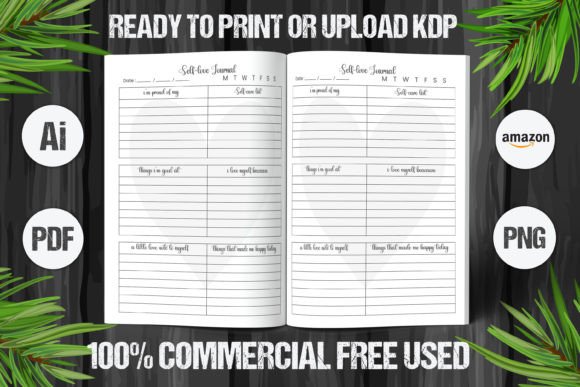
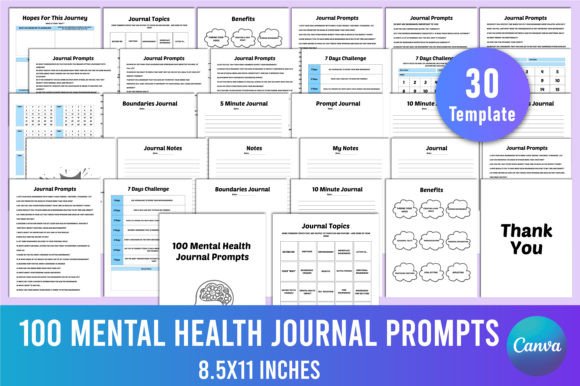
This bundle includes a professionally designed interior for an 8.5×11 inch journal, tested for Kindle Direct Publishing and fully ready for print. Inside, you’ll find a Belongs To page, a Benefits section, Journal Topics, a Hopes For This Journey opener, and the core 100 prompts spread across six pages. But what makes it truly adaptable are the supporting elements: a 7-Day Challenge, a habit tracker that spans three unique pages, journal boundaries pages, a 5-Minute Journal spread, a 10-Minute Journal layout, plus dedicated notes sections. With 30 different Canva templates, a high-resolution PDF, PNG, and JPG files, you gain immense creative control over the final product.
Why a Prompt-Based Journal Creates Instant Connection
Readers often purchase mental health journals hoping for clarity, but unstructured pages can feel intimidating. A thoughtfully curated set of prompts provides a gentle path inward. The 100 Mental Health Journal Prompts KDP resource does more than list questions — it frames a journey. The Hopes For This Journey page invites intention-setting before the first prompt is even considered. This small act of pre-reflection reduces resistance and builds trust. For a self-published author or a therapist creating client resources, this structural empathy makes the difference between a journal that sits on a shelf and one that becomes a daily companion.
By editing the prompts in Canva, you can align the tone with a specific audience. A wellness coach might add grounding language; a life coach could pivot toward goal-oriented reflection. The template remains clean, minimal, and no-bleed, so even after heavy customization, the interior stays print-safe and visually calming — a core need for any mental health resource.
Customizing the Look Without Losing Function
The editable Canva link gives you the freedom to alter fonts, colors, and placeholder text, yet the foundation stays KDP-tested. The 300 DPI, CMYK color profile, and absence of bleed edges mean your final upload sails through Amazon’s review process. If you prefer to sell on Etsy as a printable, the high-quality JPG and PNG files make it easy to deliver a crisp, instant-download product.
Design consistency matters for user trust. The journal boundaries pages, for instance, help users define emotional guardrails before diving into deep topics. When you keep that intentional flow while refreshing the visual style, the journal feels both professionally crafted and personally relevant. Some creators choose to brand the Belongs To page with a logo or QR code linking to a private community; others keep it bare for a more inclusive, giftable feel. These small creative decisions turn a template into a signature product.
Creative Adaptations Across Different Formats and Audiences
The beauty of having 30 template variations is that one prompt set can serve multiple purposes without repetition. Consider these realistic applications:
- Membership site resource: Break the 100 prompts into a 10-week email series. Use the 5-Minute Journal layout as a weekly check-in printable.
- Workshop companion: Print the 7-Day Challenge as a standalone booklet for a retreat. Include habit tracker pages so participants monitor emotional patterns alongside daily prompts.
- Social media content: Select ten prompts, redesign them as quote cards in Canva, and schedule them as engagement posts. Each post can link back to the full journal.
- Classroom or group therapy: Remove any branding elements and distribute the 10-Minute Journal pages as a group reflection tool. The notes section becomes a shared discussion space.
Because the template uses no-bleed design, you can even repurpose single pages as wall art or desktop backgrounds — a subtle mental health reminder throughout the day.
Structuring the Journal for Real-Life Use
Effective mental health tools thrive on simplicity. The included 7-Day Challenge pairs short-term accountability with the larger 100-prompt arc. Someone struggling with daily consistency can start with just seven focused entries, then transition into the habit tracker to log emotional shifts over weeks. The Journal Boundaries section quietly normalizes the idea that not every prompt must be answered fully. This respects the user’s autonomy and reduces self-criticism — a crucial element often missing from mass-market journals.
When editing this resource for your own audience, maintain that user-centered rhythm. Place the Benefits page early to reinforce why journaling matters. Follow with the Hopes page, then release one prompt per page or cluster them elegantly. The 5-Minute and 10-Minute Journal spreads can sit at the end as alternative options, giving the user permission to choose based on energy levels. Such thoughtful sequencing transforms a collection of prompts into a guided experience.
Practical Steps to Publish or Distribute With Confidence
Even if you’re new to KDP, the print-ready PDF removes technical guesswork. The file is already sized at 8.5×11 inches, 300 DPI, and CMYK — exactly what Amazon requires for a professional paperback. If you plan to sell on a platform like Gumroad or Payhip, the inclusion of JPG and PNG files lets you bundle a fully printable journal that customers can print at home or take to a local shop.
Before finalizing, test a few prompts with a small focus group. Notice which phrasing lands softly and which may need softening. With Canva, you can adjust wording in minutes. Then run a proof copy through KDP’s previewer. Because the design is no-bleed, you avoid costly formatting headaches. Once satisfied, you have a high-value low-content book that stands out in the mental wellness niche — a market that rewards authenticity over empty templates.
Keeping the Work Original Without Reinventing the Wheel
Originality doesn’t require writing 100 prompts from scratch. It comes from how you frame them, the additional sections you emphasize, and the visual narrative you build. Perhaps your version includes a short introduction about your own mental health journey, establishing E-E-A-T. Or you add a resource page with crisis helplines. Small additions like these increase reader trust and set your journal apart without overcomplicating the template.
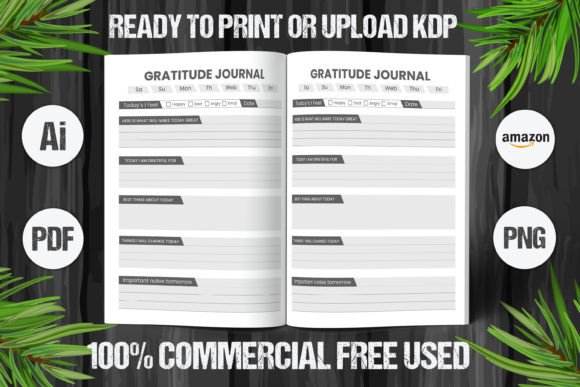
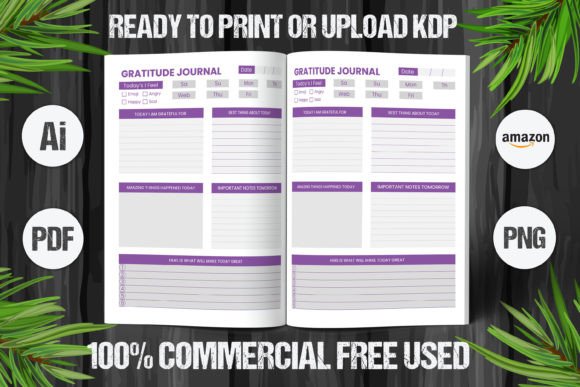
The habit tracker, for example, often becomes a beloved standalone feature. Customize the tracker to track not just habits but mood, sleep, or self-compassion moments. That one element can become the reason a customer returns to the journal. And because you have 30 template options, you can A/B test different tracker layouts to see which one your audience prefers.
Ideas That Extend Beyond the Book
Think of the 100 Mental Health Journal Prompts KDP as a starting point rather than a finished boxed product. Use the 5-Minute Journal pages to create a free lead magnet that grows your email list. Turn the My Notes sections into a separate pocket guide for teens. Record a voiceover of selected prompts and offer them as a mini podcast episode. The editable Canva link makes it simple to extract, reformat, and repurpose content while keeping the core message consistent.
For a creator selling on multiple platforms, the ability to export as PDF, JPG, and PNG means you can design a cohesive brand kit. Your journal, digital sticker set, and affirmation card deck can all share the same color palette and typography, reinforcing your visual identity without extra design work.
Balancing Inspiration With Practical Guidance
A resource that is purely inspirational often fails to deliver, while one that is overly instructional can feel dry. The 100 prompts inside this bundle find a middle ground. They guide without dictating, and the surrounding pages — Journal Topics, Boundaries, Notes — provide context that helps users internalize the practice. When you communicate this balance in your product description or marketing, you attract people who are searching not just for a journal, but for a sustainable mental health routine.
Whether you’re a coach seeking client homework, a publisher scaling your low-content line, or an individual using the Canva link to craft a personal healing tool, the structure already supports meaningful engagement. Your main task is to honor the original intention while adding your authentic voice. The result will feel genuinely helpful — and in the mental health space, that is the only metric that truly matters.